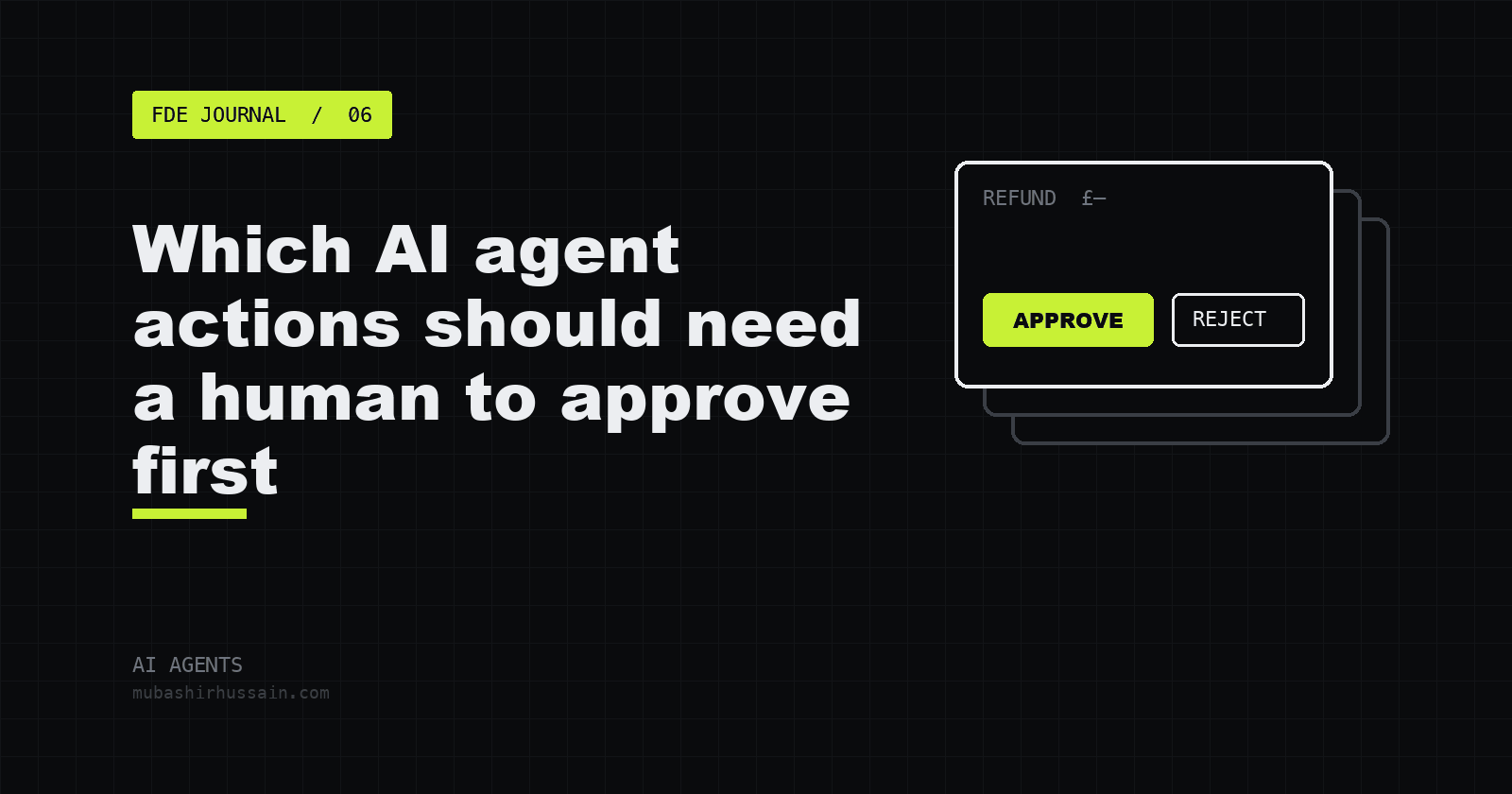
"Human in the loop" is easy to say and easy to get wrong. If a person approves everything, the agent is slower than the old process. If nobody approves anything, one bad day costs real money. The answer is to sort the actions deliberately.
Sort every action into three buckets
Free: the agent just does it
Actions that are read-only or trivially reversible. Looking up an order, checking opening hours, searching the catalogue, drafting text that nobody sees until it is approved. Make these instant.
Confirm: a person says yes first
Actions that cost money, change records or speak for you:
- Taking a payment or issuing a refund.
- Applying a discount.
- Sending a message to a customer or to you on their behalf.
- Changing or cancelling a booking.
- Deleting anything.
The approval is part of the system. The agent prepares the action, shows exactly what it will do, and waits for an explicit yes from the right person. Without the flag, the tool refuses.
Never: the agent cannot do it at all
Some things should not be possible, whatever anyone types. Paying a supplier from a customer chat, exporting the whole customer list, reading another customer's data. Do not rely on the prompt. Do not give the agent the tool.
Who approves matters
A customer confirming "yes, send my message" is one thing. A refund needs a member of staff. Design the approval to go to the right person, with the context they need to decide in seconds: what, how much, why.
Make approval cheap, not optional
- Show the action in plain language, not a JSON blob.
- One tap to approve, one tap to reject with a reason.
- Log who approved and when.
Add limits as well
Even approved actions deserve ceilings. A cap on reminders per customer, a daily limit on messages, a maximum refund without a second approver. In the sample agents on the Agents page, for example, the document-chasing agent stops after three reminders to the same person, and the operations agent will not take a payment without a confirmation.
The result is an agent that handles the boring majority quickly and hands the risky minority to a person with everything prepared. That is usually where the time savings and the safety both come from.
 Mubashir HussainForward deployed engineer